Signed in as:
filler@godaddy.com
Signed in as:
filler@godaddy.com
Discover the extraordinary diversity of the invertebrate world through a substantial programme of advanced study spanning biology, evolution, anatomy and physiology, behaviour, ecology, marine life and scientific research. From jellyfish and corals to molluscs, worms and countless other forms of animal life, the programme combines a broad foundation in invertebrate biology with opportunities to specialise in the areas that fascinate you most.
Designed for serious enthusiasts and independent learners, the 360-credit Advanced Diploma progresses through three levels of study and culminates in an independent research project. Study the complete programme over three years or longer, or begin with an individual Level 4 module and build from there.
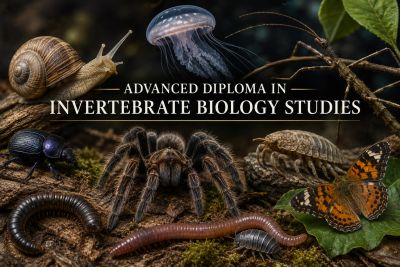
Invertebrate Biology Studies explores the extraordinary diversity, evolution, anatomy, physiology, behaviour and ecology of animals without backbones, from sponges and jellyfish to molluscs, worms and echinoderms. The programme combines broad study of invertebrate life with opportunities to specialise in particular groups and topics through optional modules and independent research.
Asynchronous lectures, reading materials and extensive resources are shared on our Moodle platform to which you will be granted access. The course is delivered entirely online, under the guidance of our expert lecturers and academic staff. The academic year begins in September but you can also enter the programme in January.
Broadly similar to a three year undergraduate degree, there are three levels (levels 4 to 6). In level 4 (year 1) you will study four core modules to give you the foundations of Invertebrate Biology studies. In year 2 you study at level 5, with further core modules to advance your knowledge, and begin to make choices from our optional modules. In year 3 you will specialise by choosing from a variety of optional modules, and complete your dissertation on a topic chosen in collaboration with the academic staff and your supervisor. The modules are detailed below.
Each 15 credit module is £200, with a 30 credit module costing £400. This includes everything for the module, with no hidden cost. The entire programme therefore costs £4800, but you can study a module at a time and exit the programme when you wish. You will receive a certificate for each module, and a certificate of completion should you exit early which summarises the extent of your study.
As these programmes are new, we are offering a limited number of places with a scholarship discount of 80%. T&Cs apply. This is an excellent opportunity to learn something new, and be involved with the development of a new course, at a really low cost. Email us today to find out more (info@wessexacademia.co.uk).
Foundations (!20 credits)
Introduces the extraordinary diversity of invertebrate animals and the fundamental biological principles used to understand their structure, function and ways of life.
Explores the origins, evolutionary relationships and diversification of the major invertebrate groups across the history of animal life.
Compares how different invertebrate groups solve the fundamental challenges of feeding, movement, respiration, circulation, excretion, reproduction and survival.
Examines the ecological roles of invertebrates, their interactions with other organisms and their responses to environmental conditions and change.
Developing expertise (90 credits)
Investigates how invertebrates perceive their surroundings, process information and produce behaviours including feeding, communication, navigation, learning and reproduction.
Explores the diversity, biology and ecology of invertebrates inhabiting marine environments from coastal habitats to the open ocean.
Develops practical and analytical approaches to identifying, observing, sampling and scientifically investigating invertebrates in field and laboratory settings.
Choose two modules from this list (30 credits)
Explores the remarkable biology, diversity and evolution of molluscs and other invertebrates characterised by shells and related protective structures.
Examines the biology, diversity, ecology and evolution of centipedes, millipedes and their relatives.
Investigates the diversity, anatomy, ecology and evolutionary significance of annelids and the many other invertebrate groups traditionally described as worms.
Explores cnidarian diversity, physiology, life cycles, nervous systems, behaviour, ecology and the remarkable biology of corals, anemones and jellyfish.
Examines the distinctive anatomy, physiology, behaviour, ecology and evolution of starfish, sea urchins, sea cucumbers and their relatives.
Investigates sponges and other early-diverging animal lineages to explore some of the fundamental events in the evolution of multicellular animal life.
Explores the extraordinary diversity of animals and other organisms living within plankton and their importance to aquatic ecosystems and global biological processes.
Specialisms (75 credits)
Develops the advanced research, experimental design, data analysis and scientific communication skills required to undertake independent work in invertebrate biology. 15 credits
Provides the opportunity to design and undertake a substantial independent investigation into a chosen area of invertebrate biology. 60 credits
Choose three options from this list (45 credits)
Critically examines current scientific evidence and debates concerning perception, learning, cognition, pain, sentience and consciousness across invertebrate taxa.
Explores the scientific and ethical foundations of invertebrate welfare and their implications for research, captivity, conservation, industry and human interaction.
Examines threats to invertebrate biodiversity and evaluates the scientific principles, strategies and practical challenges involved in its conservation.
Investigates the biology and ecology of coral reefs, their extraordinarily diverse invertebrate communities and the pressures threatening these ecosystems.
Explores the distinctive physiology, behaviour, sensory abilities, intelligence and complex lives of octopuses, squid, cuttlefish and nautiluses.
Investigates the remarkable adaptations, ecology and diversity of invertebrates inhabiting the deep ocean and some of Earth's most extreme environments.
Uses fossils, comparative biology and evolutionary evidence to investigate the origins and history of invertebrate groups through geological time.
Applies invertebrate biology to the husbandry, environmental management, breeding and welfare of invertebrates maintained in captivity.
Examines the diverse uses of invertebrates in scientific research, food production, biotechnology and industry alongside their wider ethical and environmental implications.
Add a footnote if this applies to your business